
How does UV metal printing work?
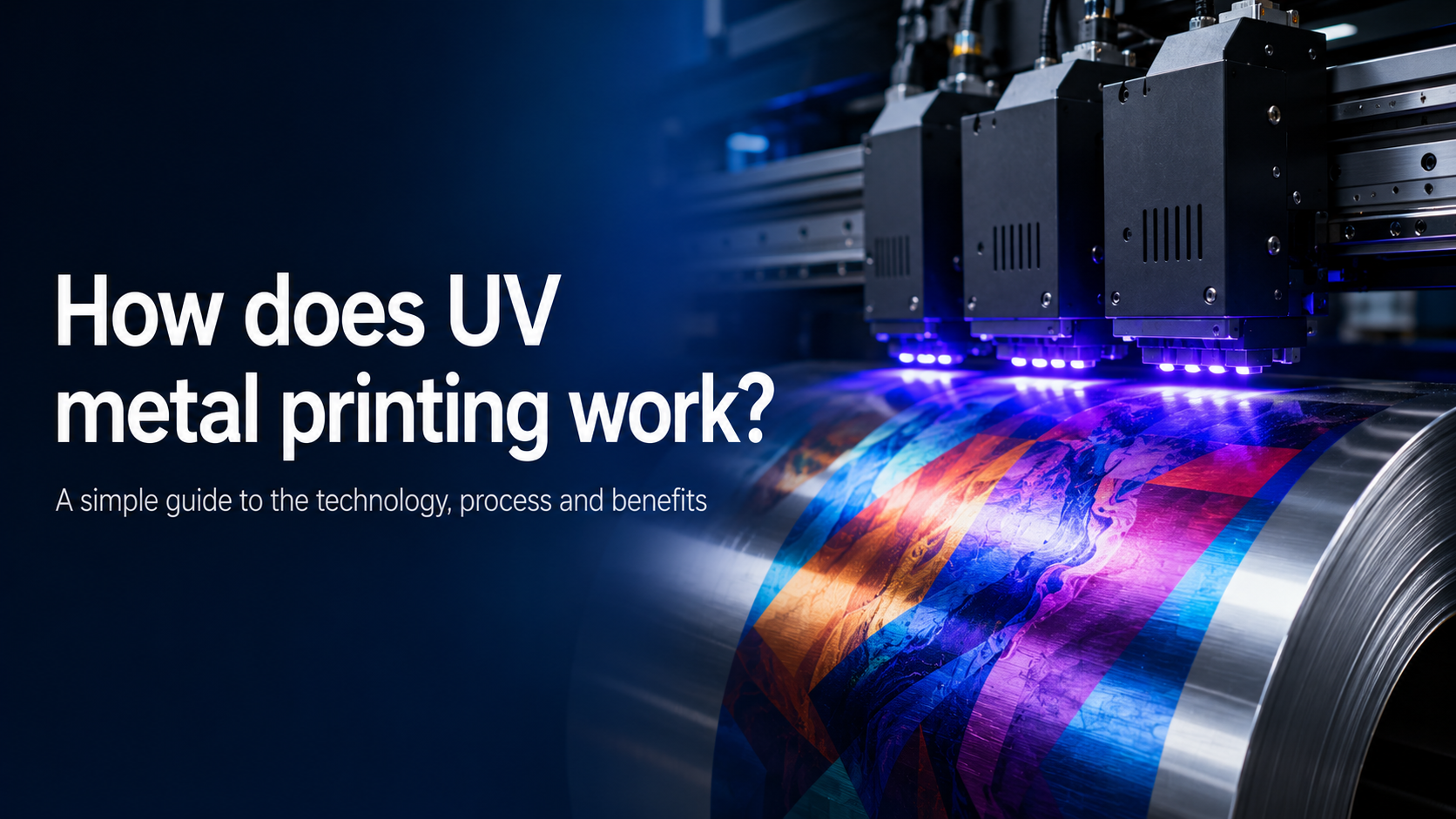
UV metal printing is a digital printing technology that applies UV-curable ink directly onto metal surfaces and instantly hardens it with ultraviolet light. Unlike traditional coating or printing methods that often require plates, screens, solvents, long drying time or high-temperature ovens, UV printing uses a controlled digital process: the image is sent from software to the printer, ink droplets are placed precisely onto the metal, and UV-LED lamps cure the ink almost immediately.
This makes the technology especially valuable for aluminum, steel, stainless steel, coated metal sheets, metal panels, appliance parts, elevator panels, packaging, signage, architectural surfaces and metal coil coating applications.
This makes the technology especially valuable for aluminum, steel, stainless steel, coated metal sheets, metal panels, appliance parts, elevator panels, packaging, signage, architectural surfaces and metal coil coating applications.
The basic principle of UV printing on metal
UV printing works through three core stages:
The process begins with a clean and properly prepared metal surface. Metal is non-porous, so ink does not naturally absorb into it as it would with paper or cardboard. For this reason, adhesion depends heavily on cleaning, surface treatment, primer or adhesion promoter, and correct ink chemistry. Proper preparation helps prevent peeling, scratching and delamination.
After preparation, the printer applies microscopic droplets of UV-curable ink onto the surface. The design is controlled digitally, so there is no need for printing plates or screens. This allows fast image changes, variable data, short runs and customized designs. In industrial digital printing, data is transferred directly from the computer to the printing machine, which makes the process highly flexible compared with fixed-plate methods.
Immediately after the ink is deposited, UV or UV-LED light activates photoinitiators inside the ink. This triggers polymerization: the liquid ink transforms into a solid polymer film in a very short time. Instead of drying by evaporation, the ink cures chemically under UV light, which reduces drying time and enables high-speed production.
Step-by-step: how UV metal printing works
1. The metal surface is cleaned
Before printing, the metal must be free from dust, oil, grease, oxide residues and production contaminants. Even a thin layer of contamination can reduce adhesion. Depending on the product, cleaning may include wiping, degreasing, plasma treatment, corona treatment, chemical pre-treatment or primer application.
This stage is critical because metal is a hard, smooth and non-absorbent substrate. The print quality and durability depend not only on the printer, but also on how well the ink bonds to the surface.
2. Primer or adhesion promoter may be applied
For some metals, especially stainless steel, aluminum or coated metal surfaces, a primer or adhesion promoter is used to improve bonding between the ink and substrate. This creates a better surface for the UV ink to grip.
In industrial production, this step can be manual, semi-automatic or fully integrated into the line, depending on the application and required durability.
3. The image is prepared digitally
The artwork is processed in RIP software, which converts the file into printable data. The software controls color channels, resolution, droplet placement, ink density and printing speed.
This is one of the main differences between UV digital printing and traditional metal decoration. Changing the design does not require a new plate, cylinder or screen. A manufacturer can switch from one pattern to another through software.
4. Inkjet printheads apply UV ink
The printheads eject tiny droplets of UV-curable ink onto the metal. In flatbed systems, the printhead scans across the metal sheet or object. In single-pass systems, the metal moves under a fixed array of printheads, allowing continuous high-speed production.
For metal coils, single-pass UV inkjet printing can be integrated into a coil coating line. This allows digital images, textures or patterns to be printed onto moving coil material without stopping the production process. IQDEMY describes its coil system as a single-pass digital printing module for metal rolls, with industrial parameters such as multiple printheads, wide printing width and high-speed operation.
5. UV-LED lamps instantly cure the ink
After the ink reaches the metal surface, UV-LED lamps expose it to ultraviolet light. The ink hardens almost instantly, forming a durable printed layer.
This instant curing provides several advantages:
UV-LED curing is especially important for industrial applications because it can reduce heat exposure compared with conventional thermal drying.
6. Optional protective coating may be added
Depending on the final application, the printed metal may receive a protective varnish, clear coat or functional top layer. This can improve scratch resistance, chemical resistance, gloss level, outdoor durability or forming performance.
For architectural panels, appliance surfaces, elevator interiors, packaging or outdoor metal elements, the protective layer is often as important as the image itself.
Why UV metal printing is different from traditional metal coating
Traditional metal decoration often relies on roller coating, screen printing, transfer printing or high-temperature baked coatings. These methods are effective for mass production, but they can be less flexible when a company needs small batches, frequent design changes or customized patterns.
UV digital printing changes this logic. Because the image is created digitally, there is no need for printing plates. This makes it easier to produce short runs, variable designs and personalized surfaces.
For coil coating, single-pass digital printing allows manufacturers to print complex patterns directly onto steel or aluminum coils. Digital coil printing can support photo-like images, textures, gradients and custom designs, while reducing setup complexity compared with traditional pattern reproduction methods.
Key advantages of UV printing on metal
High design flexibility
UV metal printing can reproduce detailed graphics, gradients, textures, logos, serial numbers and variable data. Manufacturers can quickly switch designs without changing mechanical tooling.
Fast production
Because the ink cures instantly under UV light, printed parts can move to the next production stage almost immediately. In single-pass systems, this can support continuous industrial production.
Strong adhesion and durability
With correct surface preparation, primer and ink formulation, UV prints can achieve strong adhesion on metal. Durability depends on the ink system, substrate, pre-treatment and protective coating.
Lower waste in short runs
Since there is no need for plates or screens, UV digital printing can reduce setup waste for small and customized batches.
Cleaner production potential
UV-curable inks are designed to cure under light rather than dry through solvent evaporation. This can reduce the need for solvent-heavy drying processes and support cleaner production workflows.
Where UV metal printing is used
UV metal printing is used in many industries:
For coil coating specifically, the technology is interesting because it allows manufacturers to create decorative or functional surfaces before the metal is cut, formed or assembled.
What affects print quality?
The final result depends on several factors:
Surface condition. Clean, stable and properly treated metal gives better adhesion.
Ink chemistry. UV inks must be compatible with the metal surface and the final use conditions.
Primer selection. Some metals require adhesion promoters for long-term durability.
Curing power. UV intensity, wavelength and exposure time must match the ink formulation.
Printhead precision. Stable droplet placement affects sharpness, color consistency and image detail.
Post-processing. Bending, cutting, outdoor exposure, cleaning chemicals or abrasion may require additional protective layers.
Is UV metal printing suitable for bending and forming?
It can be, but only if the full system is designed for post-forming. The ink, primer, coating and metal substrate must remain flexible enough to withstand bending without cracking or delamination.
This is especially important in metal coil applications, where printed material may later be cut, profiled, folded or formed into panels, roofing, appliance parts or façade elements.
Conclusion
UV metal printing works by applying digitally controlled UV-curable ink directly onto a prepared metal surface and curing it instantly with ultraviolet light. The process combines the flexibility of digital printing with the durability required for industrial metal applications.
For manufacturers, the main value is not only the ability to print on metal, but the ability to produce customized, high-quality and short-run designs without the complexity of traditional plate-based production. In metal coil coating, single-pass UV inkjet technology opens the door to a new model of production: flexible, digital, cleaner and more adaptable to modern market demand.
UV printing works through three core stages:
- Surface preparation
- Digital inkjet printing
- UV-LED curing
The process begins with a clean and properly prepared metal surface. Metal is non-porous, so ink does not naturally absorb into it as it would with paper or cardboard. For this reason, adhesion depends heavily on cleaning, surface treatment, primer or adhesion promoter, and correct ink chemistry. Proper preparation helps prevent peeling, scratching and delamination.
After preparation, the printer applies microscopic droplets of UV-curable ink onto the surface. The design is controlled digitally, so there is no need for printing plates or screens. This allows fast image changes, variable data, short runs and customized designs. In industrial digital printing, data is transferred directly from the computer to the printing machine, which makes the process highly flexible compared with fixed-plate methods.
Immediately after the ink is deposited, UV or UV-LED light activates photoinitiators inside the ink. This triggers polymerization: the liquid ink transforms into a solid polymer film in a very short time. Instead of drying by evaporation, the ink cures chemically under UV light, which reduces drying time and enables high-speed production.
Step-by-step: how UV metal printing works
1. The metal surface is cleaned
Before printing, the metal must be free from dust, oil, grease, oxide residues and production contaminants. Even a thin layer of contamination can reduce adhesion. Depending on the product, cleaning may include wiping, degreasing, plasma treatment, corona treatment, chemical pre-treatment or primer application.
This stage is critical because metal is a hard, smooth and non-absorbent substrate. The print quality and durability depend not only on the printer, but also on how well the ink bonds to the surface.
2. Primer or adhesion promoter may be applied
For some metals, especially stainless steel, aluminum or coated metal surfaces, a primer or adhesion promoter is used to improve bonding between the ink and substrate. This creates a better surface for the UV ink to grip.
In industrial production, this step can be manual, semi-automatic or fully integrated into the line, depending on the application and required durability.
3. The image is prepared digitally
The artwork is processed in RIP software, which converts the file into printable data. The software controls color channels, resolution, droplet placement, ink density and printing speed.
This is one of the main differences between UV digital printing and traditional metal decoration. Changing the design does not require a new plate, cylinder or screen. A manufacturer can switch from one pattern to another through software.
4. Inkjet printheads apply UV ink
The printheads eject tiny droplets of UV-curable ink onto the metal. In flatbed systems, the printhead scans across the metal sheet or object. In single-pass systems, the metal moves under a fixed array of printheads, allowing continuous high-speed production.
For metal coils, single-pass UV inkjet printing can be integrated into a coil coating line. This allows digital images, textures or patterns to be printed onto moving coil material without stopping the production process. IQDEMY describes its coil system as a single-pass digital printing module for metal rolls, with industrial parameters such as multiple printheads, wide printing width and high-speed operation.
5. UV-LED lamps instantly cure the ink
After the ink reaches the metal surface, UV-LED lamps expose it to ultraviolet light. The ink hardens almost instantly, forming a durable printed layer.
This instant curing provides several advantages:
- no long drying time;
- lower risk of smudging;
- faster handling after printing;
- compatibility with high-speed production;
- reduced need for high-temperature drying ovens.
UV-LED curing is especially important for industrial applications because it can reduce heat exposure compared with conventional thermal drying.
6. Optional protective coating may be added
Depending on the final application, the printed metal may receive a protective varnish, clear coat or functional top layer. This can improve scratch resistance, chemical resistance, gloss level, outdoor durability or forming performance.
For architectural panels, appliance surfaces, elevator interiors, packaging or outdoor metal elements, the protective layer is often as important as the image itself.
Why UV metal printing is different from traditional metal coating
Traditional metal decoration often relies on roller coating, screen printing, transfer printing or high-temperature baked coatings. These methods are effective for mass production, but they can be less flexible when a company needs small batches, frequent design changes or customized patterns.
UV digital printing changes this logic. Because the image is created digitally, there is no need for printing plates. This makes it easier to produce short runs, variable designs and personalized surfaces.
For coil coating, single-pass digital printing allows manufacturers to print complex patterns directly onto steel or aluminum coils. Digital coil printing can support photo-like images, textures, gradients and custom designs, while reducing setup complexity compared with traditional pattern reproduction methods.
Key advantages of UV printing on metal
High design flexibility
UV metal printing can reproduce detailed graphics, gradients, textures, logos, serial numbers and variable data. Manufacturers can quickly switch designs without changing mechanical tooling.
Fast production
Because the ink cures instantly under UV light, printed parts can move to the next production stage almost immediately. In single-pass systems, this can support continuous industrial production.
Strong adhesion and durability
With correct surface preparation, primer and ink formulation, UV prints can achieve strong adhesion on metal. Durability depends on the ink system, substrate, pre-treatment and protective coating.
Lower waste in short runs
Since there is no need for plates or screens, UV digital printing can reduce setup waste for small and customized batches.
Cleaner production potential
UV-curable inks are designed to cure under light rather than dry through solvent evaporation. This can reduce the need for solvent-heavy drying processes and support cleaner production workflows.
Where UV metal printing is used
UV metal printing is used in many industries:
- architectural panels and facades;
- metal ceilings and wall panels;
- aluminum composite panels;
- elevator doors and interiors;
- household appliance panels;
- metal furniture elements;
- signage and nameplates;
- decorative stainless steel;
- packaging and metal containers;
- printed aluminum or steel coils;
- industrial labels and control panels.
For coil coating specifically, the technology is interesting because it allows manufacturers to create decorative or functional surfaces before the metal is cut, formed or assembled.
What affects print quality?
The final result depends on several factors:
Surface condition. Clean, stable and properly treated metal gives better adhesion.
Ink chemistry. UV inks must be compatible with the metal surface and the final use conditions.
Primer selection. Some metals require adhesion promoters for long-term durability.
Curing power. UV intensity, wavelength and exposure time must match the ink formulation.
Printhead precision. Stable droplet placement affects sharpness, color consistency and image detail.
Post-processing. Bending, cutting, outdoor exposure, cleaning chemicals or abrasion may require additional protective layers.
Is UV metal printing suitable for bending and forming?
It can be, but only if the full system is designed for post-forming. The ink, primer, coating and metal substrate must remain flexible enough to withstand bending without cracking or delamination.
This is especially important in metal coil applications, where printed material may later be cut, profiled, folded or formed into panels, roofing, appliance parts or façade elements.
Conclusion
UV metal printing works by applying digitally controlled UV-curable ink directly onto a prepared metal surface and curing it instantly with ultraviolet light. The process combines the flexibility of digital printing with the durability required for industrial metal applications.
For manufacturers, the main value is not only the ability to print on metal, but the ability to produce customized, high-quality and short-run designs without the complexity of traditional plate-based production. In metal coil coating, single-pass UV inkjet technology opens the door to a new model of production: flexible, digital, cleaner and more adaptable to modern market demand.